
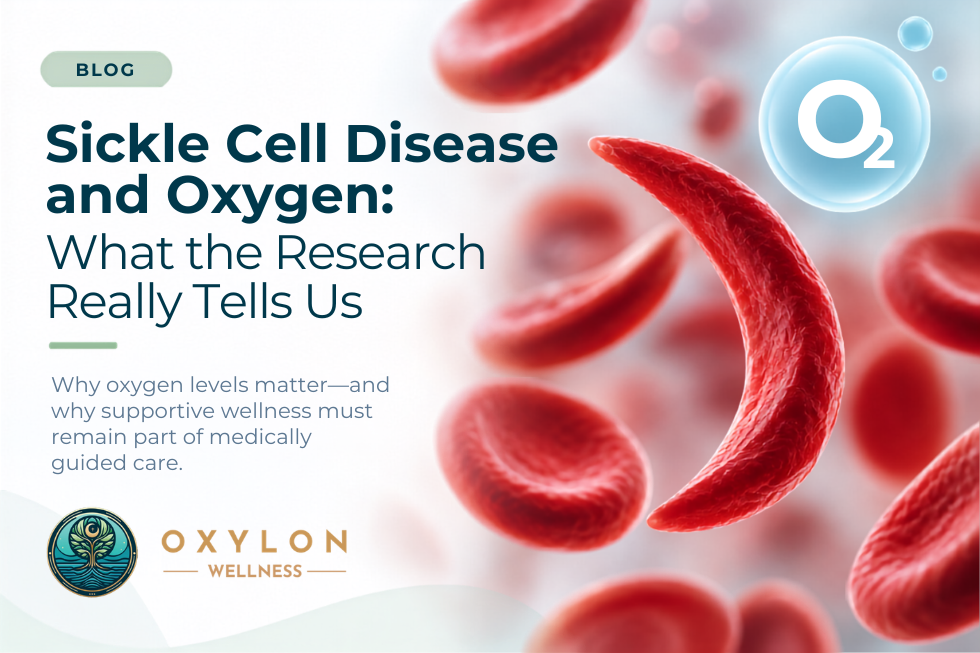
Why oxygen levels matter—and why supportive wellness must remain part of medically guided care
Oxygen is essential to every organ, tissue and cell in the body. For people living with sickle cell disease, however, the relationship between oxygen and health is especially complex. Research has connected low oxygen levels—particularly during sleep—with a higher risk of painful episodes. This has led researchers and clinicians to explore how monitoring and medically prescribed oxygen may fit into comprehensive sickle cell care.
The key message is not that oxygen is a stand-alone cure or a replacement for medical treatment. Rather, the research reinforces the importance of preventing and promptly addressing low oxygen levels under the supervision of a qualified healthcare professional
What is sickle cell disease?
Sickle cell disease, or SCD, is a group of inherited blood disorders that affect hemoglobin, the protein inside red blood cells that carries oxygen throughout the body.
Healthy red blood cells are normally round and flexible, allowing them to move easily through small blood vessels. In SCD, abnormal hemoglobin—known as hemoglobin S—can cause red blood cells to become rigid, sticky and crescent-shaped, especially under low-oxygen conditions.
These altered cells may break down earlier than normal, contributing to chronic anemia. They can also obstruct small blood vessels, limiting blood flow and oxygen delivery to tissues. This process, called vaso-occlusion, can produce episodes of severe pain and contribute to complications including acute chest syndrome, stroke, infection and organ damage. Sickle cell anemia is generally the most severe form of SCD.
Who is affected?
Sickle cell disease is a global health concern. According to the World Health Organization, an estimated 7.74 million people were living with SCD in 2021, with approximately 515,000 babies born with the condition that year. Nearly 80% of global cases occur in sub-Saharan Africa. SCD is also more common among people whose ancestry is from parts of Africa, the Mediterranean, the Middle East, India, the Caribbean and Central and South America.
The Centers for Disease Control and Prevention estimates that approximately 100,000 people in the United States live with SCD. More than 90% are non-Hispanic Black or African American, while an estimated 3% to 9% are Hispanic or Latino. In the United States:
- SCD occurs in approximately 1 in every 365 Black or African American births.
- It occurs in approximately 1 in every 16,300 Hispanic American births.
- About 1 in 13 Black or African American babies is born with sickle cell trait.
Sickle cell trait is not the same as sickle cell disease. A person with the trait has inherited one sickle cell gene and usually does not experience the symptoms of SCD, but the gene can be passed to their children.
Why researchers are interested in oxygen
The research article that inspired this discussion explains that reduced oxygen can encourage hemoglobin S to polymerize, or bind together. This process contributes to red-cell sickling and can increase the possibility of impaired blood flow.
The article also highlights several known or suspected triggers for vaso-occlusive episodes, including dehydration, infection, cold exposure, physical exertion, stress, altitude and hypoxia. These factors do not affect every person in the same way, which is why individualized medical guidance and a personal action plan are so important.
One frequently cited study followed 95 children with SCD and found a significant association between lower nighttime oxygen saturation and a higher rate of painful crises. This finding shows an important relationship, but it does not prove that routine oxygen therapy will prevent crises in every patient.
What did the featured article report?
The featured article, originally published in 2020 and updated in 2021, proposed medically prescribed supplemental oxygen as a possible preventive strategy. Its author described clinical observations involving 20 patients who used oxygen by nasal cannula before or during sleep and reported a substantial reduction in vaso-occlusive episodes.
Current clinical guidance supports supplemental oxygen when a person with SCD is hypoxemic. Guidance adapted from the National Heart, Lung, and Blood Institute recommends oxygen during a vaso-occlusive crisis when room-air oxygen saturation is below 95%.
Prevention means comprehensive, evidence-based care
Preventive care for SCD is not one treatment or one wellness practice. It is a coordinated plan developed with a hematologist or sickle cell specialist. Depending on the individual, that plan may include:
- Regular medical monitoring and recommended screenings
- Vaccinations and infection prevention
- Hydration and avoidance of known personal triggers
- Hydroxyurea or other disease-modifying treatment when appropriate
- Blood transfusion protocols for specific indications
- Evaluation of sleep-disordered breathing or unexplained nighttime oxygen drops
- A written plan for pain episodes and emergency symptoms
- Discussion of transplant or gene-therapy options for eligible patients
Anyone with SCD who experiences chest pain, trouble breathing, fever, signs of stroke, severe anemia symptoms or an uncontrolled pain crisis should seek urgent medical care. A wellness appointment should never delay emergency evaluation.
Where does Oxylon Wellness fit?
Oxylon Wellness offers warm, oxygen-enriched Kaqun baths as a complementary wellness therapy designed to create time for rest and relaxation and maybe a beneficial therapy for sickle cell disease.
People living with SCD may still value restorative wellness practices as part of their broader self-care routine, but any oxygen-bath session should first be discussed with their hematologist—especially when anemia, cardiopulmonary concerns, skin ulcers, infection, temperature sensitivity or an active crisis is present. An Oxylon session should complement, never replace, prescribed care.
The research takeaway
The science makes one point clear: oxygen availability matters in sickle cell disease, and low oxygen levels deserve prompt medical attention. Research connecting nighttime oxygen desaturation with painful crises supports screening and further study. The featured article adds an interesting clinical hypothesis about preventive supplemental oxygen.
For Oxylon Wellness, responsible education means honoring both the promise and the limits of the evidence. We welcome conversations about relaxation and complementary wellness while encouraging every person with SCD to work closely with a qualified sickle cell care team.
Research and educational sources
- Centers for Disease Control and Prevention, Data and Statistics on Sickle Cell Disease
- World Health Organization, Sickle-cell disease fact sheet
- Hargrave DR, Wade A, Evans JPM, Hewes DKM, Kirkham F. Nocturnal oxygen saturation and painful sickle cell crises in children. Blood. 2003;101(3):846–848.
- American Society of Hematology, Management of Acute Complications of Sickle Cell Disease, adapted from the NHLBI Expert Panel Report.
- Featured article supplied for this blog: Sickle Cell Pain Crisis: Using Oxygen to Prevent and Manage, originally published January 30, 2020 and updated May 5, 2021.
For Oxylon Wellness, responsible education means honoring both the promise and the limits of the evidence. We welcome conversations about relaxation and complementary wellness while encouraging every person with SCD to work closely with a qualified sickle cell care team.
Disclaimer:
This article is for education only and is not medical advice. Oxylon Wellness does not diagnose, treat, cure or prevent sickle cell disease. Oxygen-enriched baths are not a substitute for prescribed oxygen, medication, transfusion, emergency care or treatment from a hematologist. Consult your healthcare professional before using any complementary wellness service.