
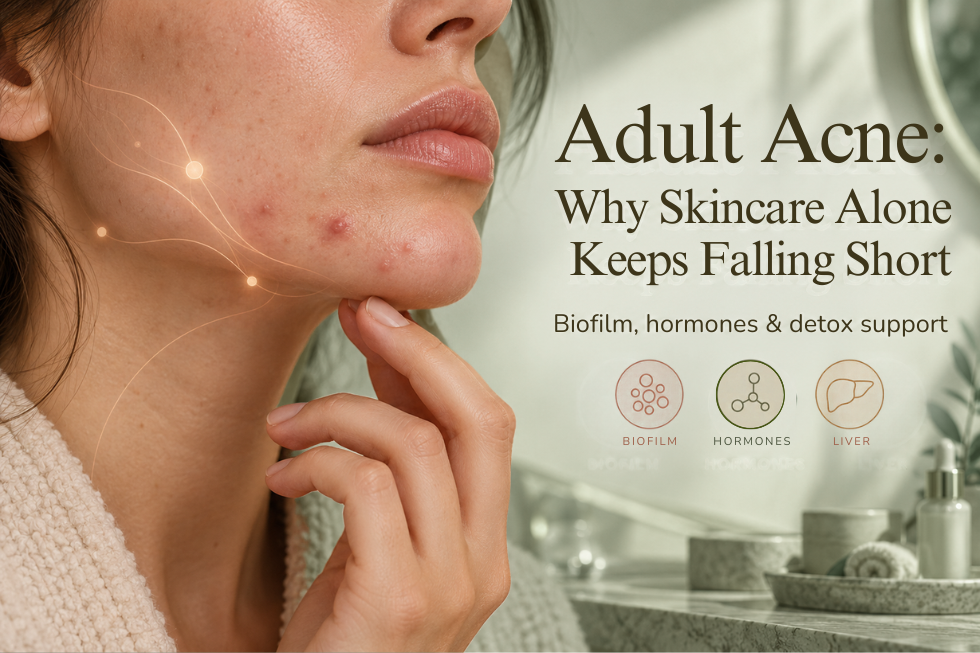
Adult acne, when you are years past the age anyone warned you about
You are standing in the same aisle you stood in at sixteen, reading the same claims on the same bottles, except now you are 20 years older and have 16 year old of your own and you have a meeting at nine. There is a deep sore spot along your jaw that has been there for eleven days and shows no sign of leaving. It is not a whitehead. It never comes to a head. It just sits there under the skin, aching when you rest your face on your hand.
You have a shelf of products. Some of them cost more than your monthly gym membership. You have done the twelve week trial of the gentle routine, the twelve week trial of the aggressive routine, the elimination of dairy, the switch to a silk pillowcase, the changing of the pillowcase every second night. A few of them helped a little. None of them held.
What makes adult acne particularly wearing is that nobody takes it seriously as a real problem. It is filed under vanity, or under teenage, or under something you should have grown out of. Meanwhile you are turning your face away in photos, angling your video calls, and quietly deciding not to go to things.
If you have been at this for years and the answers you have been handed have never quite fit, there is a different way of framing the problem that is worth your time.
The daily version, not the textbook version
The clinical description of acne lists causes as blocked follicles, excess oil, bacteria, and skin inflammation. That is all accurate and it explains almost nothing about your condition.
It does not describe the specific dread of feeling one starting, that deep tender ache under the surface a day or two before anything is visible. It does not describe how adult breakouts tend to sit low on the face, along the jaw and chin and neck, in the places that makeup does not sit well over. It does not describe the marks left behind that last far longer than the spot did, so that even a good month still looks like a bad one.
It also does not describe the pattern recognition you have built up. You know roughly which week of the month is worse. You know that a stretch of poor sleep and takeout food shows up on your face about five days later. You know it, and no product you have bought has ever been designed to do anything about it.
Why the products keep almost working
Most acne products act on the surface. They clear oil, they encourage the top layer of skin to turn over faster, they reduce the population of bacteria sitting on the skin. Those are real actions and they are why a new routine often gives you two or three promising weeks.
Then the promising weeks end. The skin adapts, or the underlying pressure that was producing the breakouts simply continues, and you are back where you started with a more expensive shelf.
That pattern is worth taking seriously note of, because it shows a specific issue. It is the signature of an approach that is doing something genuine but is acting in the wrong place. It means you have an issue that can be helped but requires a more complete and advanced approach. You are not beyond help.
Dr. Zodkoy’s working view: acne is not only a skin issue
Dr. Steven Zodkoy, DC, CNS, DACBN, is Oxylon Wellness’s Clinical Protocol Advisor and Referral Partner, and he wrote the condition protocols Oxylon follows. He has spent more than 35 years working with chronic and difficult health issues, and he is the author of Misdiagnosed: The Adrenal Fatigue Link. He practices at Monmouth Advanced Medicine in New Jersey and does not practice at Oxylon.
His starting position on acne is blunt. Acne is not just a skin issue. In his framing, most cases involve three things at once: a biofilm on the skin, slow liver detoxification, and an overabundance of hormones. All of it is aggravated by a poor diet and by the chemicals we are surrounded by.
Read that list again and notice that only one of the three is on your face. The other two are internal, and neither of them is addressed by anything you can buy in a jar.
The single idea that changes the picture
Here is the part that reframes everything else, and it is the reason this article exists.
Your body produces hormones, they do their work, and then they have to be processed and cleared. The liver is the central organ to detox and to do that clearing. When clearing is efficient, hormones rise and fall the way they are meant to without any signs or symptoms. But, when clearing is slow, they accumulate, and the surplus has to go somewhere.
In Dr. Zodkoy’s framing, one of the places that surplus shows up is the skin. Which leads to the conclusion that matters most: if the liver is not clearing hormones efficiently, no amount of surface skincare resolves the problem, because you are working downstream of the actual issue. This is the difference between treating the cause to prevent an issue or focusing on treating the symptoms over and over again.
That is not a criticism of your routine. Your cleanser was never designed to influence hormone clearance. It was designed to act on the surface, and the surface is where the problem becomes visible, not where it is generated.
Why this explains the things that confused you
Once you hold that frame, several of your own observations stop looking contradictory
- Why it got worse in adulthood, not better. Hormonal patterns shift across your thirties and forties, and the load on your clearing capacity shifts with them.
- Why stress weeks show up on your face. Stress changes both hormone output and the resources available to process it.
- Why alcohol and a run of sugary food seem to cost you. Both add to what the liver is already handling.
- Why the marks and the deep lesions last so long. Inflammation that keeps being fed does not settle on its own schedule.
The third piece: biofilm
The remaining element in his model is the biofilm on the skin itself. A biofilm is a protective layer that microbial communities build around themselves. Underneath it, they are far less exposed to whatever is applied on top.
That gives you a plain explanation for something you may have experienced as a personal failing. You were being diligent, applying things consistently, and the skin behaved as though very little was reaching it. In this framing, that is not a failure of diligence. It is what a protected surface does.
It is also why Dr. Zodkoy built the Oxylon acne protocol around oxygen delivery and circulation rather than around a stronger topical product, and why lumbrokinase, an ingredient associated with breaking down biofilm structures, is one of the four he highlights. The sequence of sessions and the reasoning behind it are covered in the second article on this page.
Where to start, in Orange County
If the surface has been your whole approach for years, the useful change is looking at what sits underneath it. That is a conversation, not another product.
Start with information rather than another shelf of products. Fill out the short acne form and our team at Oxylon Wellness in Costa Mesa will reach out.
Disclaimer:
This article is for educational purposes only and is not medical advice. Oxylon Wellness does not diagnose, treat, or cure any medical condition, and the protocols described are wellness programs intended to run alongside, not in place of, care from your own physician. Individual experiences vary. Always consult your healthcare provider before beginning any new wellness program, dietary change, or supplement, and check for allergies. Protocols were developed by Dr. Steven Zodkoy, DC, CNS, DACBN, who is Oxylon Wellness’s Clinical Protocol Advisor and Referral Partner and does not practice at Oxylon Wellness.