
When Pain Stops Being an Event and Becomes the Background of Your Life
You have stopped saying much about it. Somewhere in the second or third year you noticed that describing it out loud made people uncomfortable, or made them offer a stretch you have already tried, so now you answer “fine” and get on with the afternoon.
The pain itself may have changed shape. It moves. Some mornings it is your low back and by Thursday it has migrated to a shoulder blade or a hip or the side of your neck, and you cannot find the injury that would explain the route it takes.
What tires you is not only the intensity. It is the planning. You choose chairs by how long you can sit in them. You decide whether an evening out is worth what tomorrow will cost. That accounting runs quietly all day, and it is exhausting in a way that does not show up on any image.
The scans came back unremarkable, and that was the hardest part
Many people describe the same sequence. Imaging shows some wear that seems reasonable for your age. Bloodwork looks acceptable. You are told the structure is holding up better than the pain suggests, which is meant as reassurance and lands as dismissal.
The trouble is that you were not imagining anything. The pain is real, it is measurable in how your day narrows, and being told the pictures look fine does nothing to change Wednesday morning.
That gap between what the images show and what your body reports is not a failure of your reporting. It is a sign that the question being asked may be the wrong one.
Why the usual answers have felt incomplete
Most of the care offered for persistent pain aims at the place that hurts. Injections, manual work, topical products, rest, and various forms of strengthening are all pointed at tissue. Sometimes that helps for a while.
But if the problem were only tissue, the relief would tend to hold. What many people find instead is a pattern of temporary improvement followed by a return, often to the same spot, often on the same schedule. Something is regenerating the signal.
Dr. Zodkoy’s working view is that this pattern makes sense once you stop treating pain as purely a local event. In his framing, chronic pain is persistent pain lasting months or longer, driven by ongoing nerve, tissue, or inflammation issues that disrupt normal pain-processing pathways. The processing part is the piece most approaches skip.
Chronic pain is as much a brain issue as a neuromuscular one
This is the line at the center of Dr. Zodkoy’s chronic pain protocol, and it is worth sitting with, because it is easy to hear wrong.
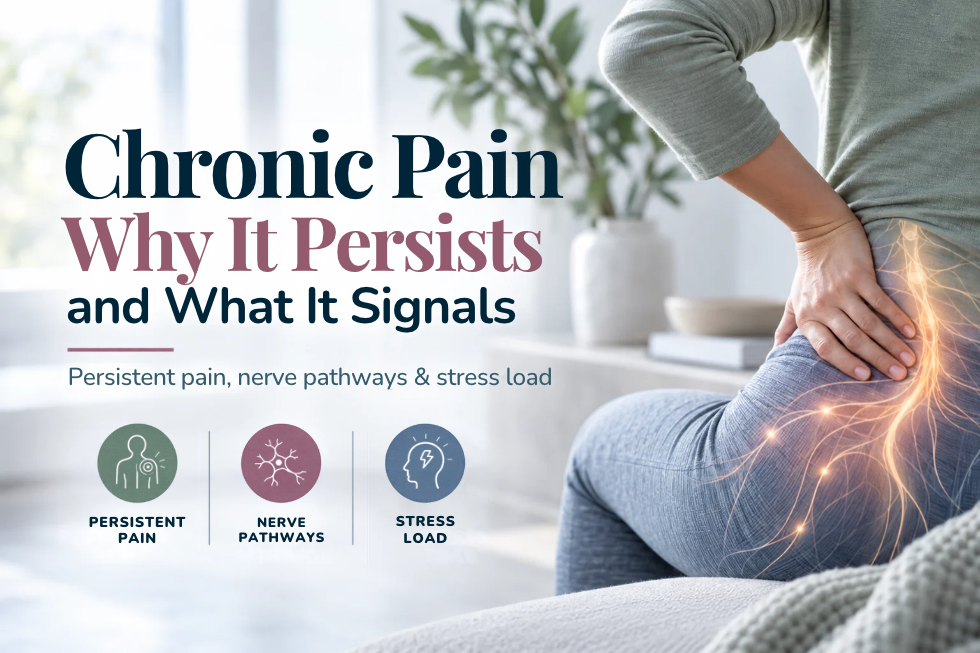
It does not mean the pain is imaginary. It means that pain is a signal, signals travel a pathway, and pathways change with use. The nervous system that carries and interprets the message is part of the system that has to be supported, not just the muscle or joint at the far end of it.
His practical conclusion follows from that: pain that repeats strengthens the pathway that produces it. The longer a signal runs, the more efficient the route becomes. That is why the fifth year of a problem can feel less predictable and more widespread than the first, even when nothing new has happened to the tissue.
It also explains why stress, poor sleep, and a hard week so reliably turn the volume up. Those things act on the same nervous system that is carrying the signal.
What that reframing changes
Once mind and body are both in the picture, several confusing things become less confusing.
- Pain that migrates makes sense, because a sensitized system is not confined to one structure.
- Good days and bad days that do not track with activity make sense, because load is only one input among several.
- Relief that fades makes sense, because addressing the tissue without addressing the pathway leaves half the system untouched.
- Fatigue that accompanies the pain makes sense, because running a heightened stress response all day is genuinely expensive.
None of this means the tissue does not matter. It means the tissue was never the whole account.
Your pain may have a more specific name
Chronic pain is a wide door, and it is the right door for many people. Some readers, though, will recognize themselves more precisely in one of the narrower patterns Dr. Zodkoy has also written protocols around.
If your pain is mostly burning, tingling, numbness, or electrical sensation in the hands and feet, the neuropathy material will speak to your situation more directly. If your worst days are headaches with light and sound sensitivity, look at the migraine protocol. If your pain is widespread and comes bundled with deep fatigue and unrefreshing sleep, the fibromyalgia page is closer to home.
If your symptoms began or worsened after a water leak or a damp building, or if they have always come with digestive trouble and brain fog, the yeast and mold material is worth reading. And if the skin is involved, whether that is chronic irritation, spots that are slow to settle, or rashes that arrive with flares, there is a page for that as well.
Any of those may be the better fit. The chronic pain approach described here still applies underneath them, because they share a great deal of the same reasoning.
Where a starting point comes from
Before anything else in Dr. Zodkoy’s chronic pain protocol, there is a Max Pulse wellness screening, which looks at arterial stiffness and stress levels. It does not name a disease and it is not a medical test. It is a way to put numbers on two things that are usually described only in adjectives.
That matters for a reader who has spent years being told everything looks fine. Having a baseline gives you something to compare against later, which is often the first time in a long while that change becomes visible rather than merely felt.
Oxylon Wellness in Costa Mesa also offers a ZYTO wellness screening alongside it. Together they are the front end of the protocol, and they exist to inform the sequence that follows, not to label you.
Taking the next honest step
Before anything else in Dr. Zodkoy’s chronic pain protocol, there is a Max Pulse wellness screening, which looks at arterial stiffness and stress levels.
It does not name a disease and it is not a medical test. It is a way to put numbers on two things that are usually described only in adjectives. That screening exists to inform the sequence that follows, not to label you.
Start with real information about where your body is right now. Fill out the short chronic pain form and our team at Oxylon Wellness in Costa Mesa will reach out.
Disclaimer:
This article is for educational purposes only and is not medical advice. Oxylon Wellness does not diagnose, treat, or cure any medical condition, and the protocols described are wellness programs intended to run alongside, not in place of, care from your own physician. Individual experiences vary. Always consult your healthcare provider before beginning any new wellness program, dietary change, or supplement, and check for allergies. Protocols were developed by Dr. Steven Zodkoy, DC, CNS, DACBN, who is Oxylon Wellness’s Clinical Protocol Advisor and Referral Partner and does not practice at Oxylon Wellness.