
Why Your Feet Burn at Night and Nobody Seems to Have a Real Answer
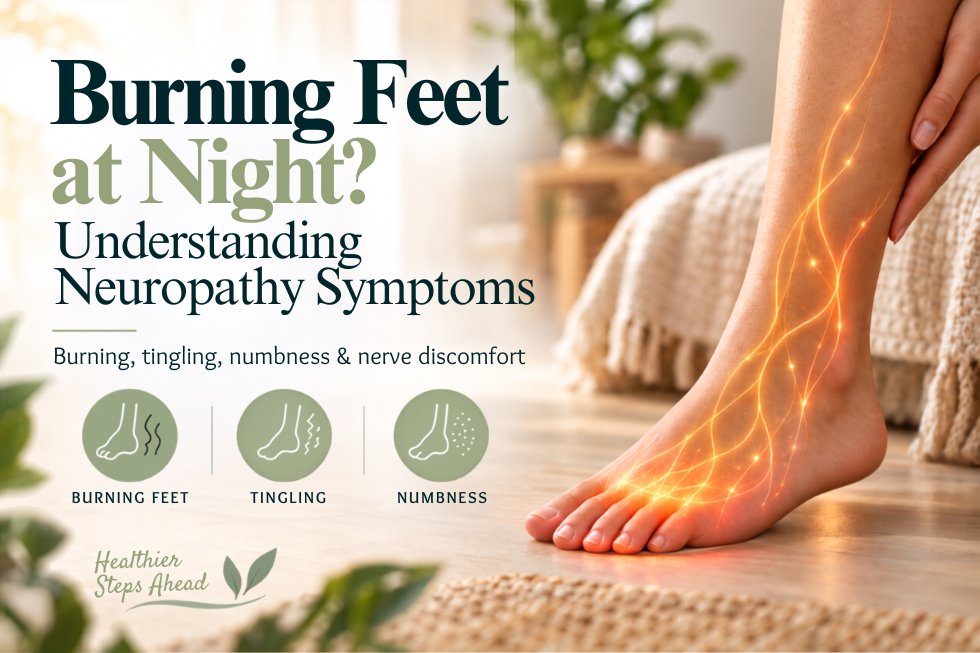
Neuropathy symptoms usually start small enough to ignore. A sock that feels bunched when it is perfectly flat. A toe that goes to sleep and takes its time waking up. Then one night you get into bed, the house goes quiet, and your feet start to burn as though you left them too close to a heater.
Daytime is manageable at first but the night is the problem. You lie there running through the arithmetic of how many hours are left, whether the covers are making it worse, whether standing on the cold bathroom tile will buy you twenty minutes.
By the time most people search for answers, they have already been through several rounds of being told this is simply what happens now. Nerve damage, aging, blood sugar, chemotherapy, or the most frustrating word of all, idiopathic, meaning no one is certain where it came from.
If that has been your experience, this article is not going to promise you anything. It is going to describe what is actually happening in plain language, and explain how Dr. Steven Zodkoy, a chiropractor, nutritionist and Oxylon Wellness’s Advisor, thinks about the problem differently.
What neuropathy symptoms actually feel like, not the textbook version
The clinical description of Neuropathy symptoms include pain, burning, hypersensitivity, tingling, numbness, or weakness in the hands or feet. That covers the ground, but it does not capture the day.
What people actually describe is more specific and stranger than that:
- Burning or scalding sensations in the feet that intensify when everything else quiets down at night
- Pins and needles that arrive without warning and have nothing to do with how you were sitting
- Numbness that makes you uncertain where the floor is, especially in the dark or on stairs
- Hands that drop things, fumble buttons, or lose their grip on a coffee cup
- Feet that feel cold to you and warm to the touch of anyone else
- Weakness that shows up as hesitation, not as an inability, when stepping off a curb
- A sock is over my feet and makes them feel weird
It is the varied and overlapping symptoms that often causes confusion. They do not link to one definitive issue but rather multiple issues. It is not until your, or your doctor, recognizes that nerves carry separate fibers, like a cable vs a wire, to the body that your symptoms make sense. This means that a person with neuropathy may have symptoms affecting the fiber to the muscles, pain or sensation of the area, but it may also affect 2 or 3 of those fibers.
Why the cause matters less than most people expect
Neuropathy arrives by several roads. It can be part of aging. It can follow years of elevated blood sugar. It can follow chemotherapy or other medications. And in a large number of cases, no clear origin is ever identified.
Dr. Zodkoy’s working view is that the road matters for your physician and for managing whatever set it in motion, but the destination is remarkably consistent. Whatever the cause, you end up with nerve tissue that is damaged and that is not getting what it needs to function well.
That reframing matters if you have been stuck. Being told your neuropathy is idiopathic can feel like being told nothing can be done, because no cause means no target. Dr. Zodkoy’s approach starts from the tissue itself rather than from the label attached to it.
Why the usual answers have felt incomplete
Most people arrive at this point having tried the obvious things, and they have often helped a little.
Medication for nerve pain quiets the signal. That is genuine relief and worth having. What it does not do is address the condition of the nerve tissue underneath, which is why so many people describe it as turning the volume down rather than changing the song.
Better blood sugar control is important and your physician is right to press on it. But it addresses one road in, and many people with well managed numbers still have burning feet.
Rest, elevation, better shoes, and cushioned insoles all help with comfort. They do not change what is happening at the level of the nerve.
So you end up with a stack of partial answers and a night that still feels long. That is not a failure of effort on your part. It is what happens when the pieces you have been given do not include one particular piece.
The piece Dr. Zodkoy focuses on
Nerves are metabolically demanding tissue. They need a steady supply of oxygen and nutrients delivered by very small blood vessels, and they need those deliveries constantly.
The hands and feet sit at the end of that delivery route. They are the furthest points from the pump, served by the smallest vessels, and they are the first places to notice when delivery falls behind. That is why neuropathy so often starts in the toes and fingers rather than the thighs and shoulders.
Dr. Zodkoy’s working view is that a great deal of what people experience as neuropathy is what happens when nerve tissue is trying to function and repair itself on an oxygen supply that is not keeping pace with what it needs. His Oxylon protocol is built around improving that delivery, and it is a wellness program designed to run alongside your physician’s care, not to replace any part of it.
.
Where a wellness screening fits
The protocol starts with information, this determines if you are a good candidate for success with the program. The Max Pulse wellness screening looks at arterial stiffness and stress levels, which is a way of asking how well your circulatory system is currently moving anything to the far edges of your body.
This is a wellness screening rather than a medical evaluation, and it does not tell you what caused your neuropathy. What it does is give you a starting point that reflects your own circulation rather than an average.
For many people, this is the first time anyone has looked at the delivery question at all. That alone tends to change the conversation from what is wrong with me to what specifically is happening here.
If any of this sounds like your evenings
You are not imagining the burning. You are not exaggerating the numbness. And you have not simply reached the age where this is your life now without recourse.
Oxylon Wellness in Costa Mesa follows the neuropathy protocol Dr. Zodkoy developed over more than three decades of working with chronic and difficult health issues. The protocol combines AVACEN sessions, Kaqun oxygen baths, and laser therapy in a specific sequence, along with home care you do between visits. Dr. Zodkoy does not practice at Oxylon, and clients who want a personalized plan can reach his office in Freehold, New Jersey at 732-308-0099.
The best first step is the simplest one. Tell us what you are dealing with, and we will take it from there with real information in front of you.
Your feet are telling you something. Fill out the short neuropathy form and our team at Oxylon Wellness in Costa Mesa will reach out.
Disclaimer:
This article is for educational purposes only and is not medical advice. Oxylon Wellness does not diagnose, treat, or cure any medical condition, and the protocols described are wellness programs intended to run alongside, not in place of, care from your own physician. Individual experiences vary. Always consult your healthcare provider before beginning any new wellness program, dietary change, or supplement, and check for allergies. Protocols were developed by Dr. Steven Zodkoy, DC, CNS, DACBN, who is Oxylon Wellness’s Clinical Protocol Advisor and Referral Partner and does not practice at Oxylon Wellness.