
Why oxygen, why that order, and why this protocol has no finish line
Most recovery products act on one input. A protocol that sequences several things has to explain why it sequences them, or it is just a bundle.
The Oxylon sports recovery protocol has a specific order and a specific reason for that order. It also has a structural feature that none of the other protocols Dr. Zodkoy wrote for Oxylon share: no end date.
This article explains the mechanism he is working from, why each step sits where it sits, and why an open ended structure is the right shape for an athlete rather than a limitation.
Start with the delivery problem
Dr. Zodkoy’s view is that recovery falters when inflammation stays high, nutrients run low, sleep is disrupted and tissue repair lags behind training stress.
Three of those four depend on delivery. Repair requires materials and oxygen arriving at the tissue that needs them. Clearing the byproducts of hard work requires the same route in the other direction. Nutrient status is not only about what you eat, it is also about what reaches the tissue that is asking for it.
That is the pivot in the whole approach. If repair is limited by what gets delivered and what gets carried away, then supporting circulation and oxygen uptake is not an add on to recovery. It is the ground floor of it.
And the exchange itself does not happen in the big vessels. It happens in the capillaries, which is why the protocol opens where it does
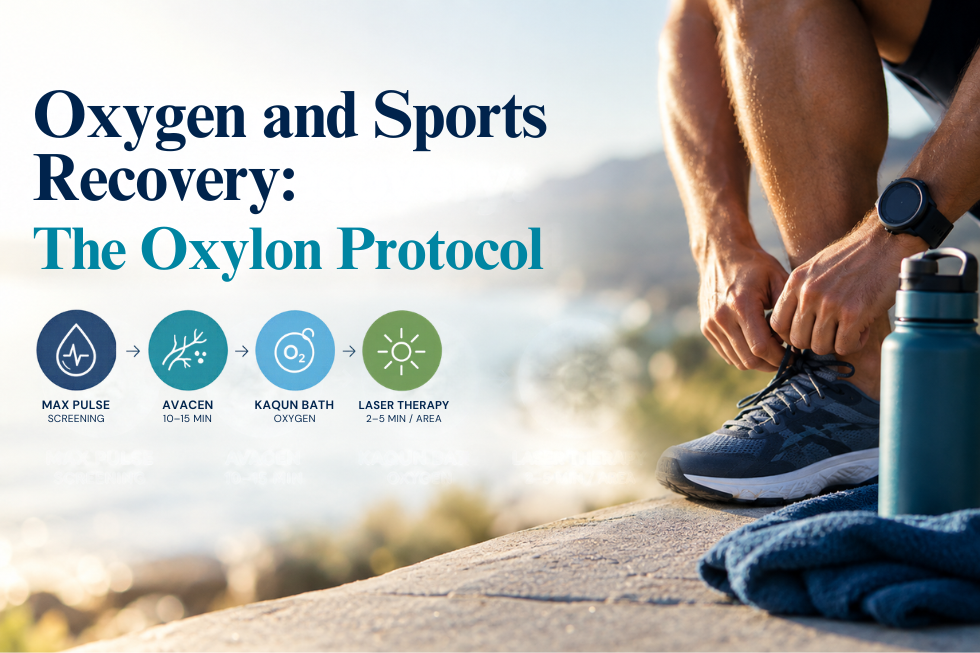
Step one: the Max Pulse wellness screening
Before anything is scheduled, the protocol calls for a Max Pulse screening to look at arterial stiffness and stress levels.
It is a wellness screening, not a medical test, and it does not identify a disease. What it gives you is a picture of the circulatory and stress side of the system before the program starts. Two athletes with the same weekly volume can be carrying very different levels of systemic stress, and that difference shapes how much training turns into adaptation.
It is also a starting point you can compare against later.
Step two: AVACEN, 10 to 15 minutes before every bath
The AVACEN device is used for 10 to 15 minutes immediately before the bath. Its purpose in the protocol is to maximize capillary dilation and blood flow.
This is the preparation step, and its placement is the whole point. Capillaries are the site of exchange with tissue. Opening that network before the oxygen step means the delivery route is ready when the oxygen arrives, rather than being opened afterward when the opportunity has passed.
Think of it the way you think of a warm up. You do not start the hard effort cold and expect the same quality of work. Same logic, applied to circulation.
Step three: the Kaqun oxygen bath
With circulation prepared, the bath follows. In this protocol the bath is described as maximizing oxygen uptake for performance, tissue repair, reduced inflammation and antimicrobial benefit.
Line those up against the four factors from the framing and the fit is not subtle. Reduced inflammation addresses the item that drives the loop. Support for tissue repair addresses the item that lags behind training stress. Oxygen uptake supports performance itself. This is why the bath is the center of the protocol rather than one option among several.
Running the bath before the AVACEN step would invert the logic: delivering oxygen through a capillary network that has not yet been opened to carry it.
Step four: laser therapy, 2 to 5 minutes per area
Laser therapy is applied for 2 to 5 minutes over the area most affected, and multiple locations can be chosen in a single visit.
The first three steps work on the system as a whole. This one is local, and for athletes that usually means the places that have been grumbling: an Achilles, a hamstring insertion, a shoulder, the knee that always speaks up in week three of a block.
The option of multiple locations in one visit matters here, because athletes rarely have one sore site. They have a list.
The structural difference: two rhythms, no end date
Here is where this protocol departs from every other one Dr. Zodkoy wrote for Oxylon. The others run for a defined stretch of weeks and then transition to maintenance. This one does not have a week count at all, because a training life does not have one either.
Instead it runs on two rhythms.
|
Rhythm |
When it applies |
|---|---|
|
Three baths a week |
For acute episodes, or to maximize performance ahead of an event or a game |
|
One bath a week |
On a regular basis, for maintaining performance on an ongoing footing |
|
A monthly bath |
To maintain the benefits achieved, which the protocol calls crucial for long term results |
The denser rhythm is what you reach for when something has flared or when a date is circled on the calendar. The lighter rhythm is the default that runs quietly across a season.
That fits how athletes actually live better than a fixed program would. You have base periods and build periods, races and matches, off seasons and comebacks. A structure that can tighten before a target and loosen afterward matches that reality instead of fighting it.
Why the monthly bath is not the part to drop
The protocol is explicit that a monthly bath to maintain the benefits achieved is crucial for long term results, and this is the piece most likely to be quietly abandoned once things feel good again.
The logic is straightforward. The pressures do not go away. You are still training. Inflammation is still generated by hard work, nutrients are still drawn down, and repair demand does not decline because a recent block went well. A structure that addresses an ongoing load assumes ongoing support.
The five highlighted ingredients
Dr. Zodkoy highlights five ingredients in the sports recovery protocol. They are named here for information only, without brands or dosages, and you should check for allergies and speak with your own healthcare provider before starting anything.
|
Rhythm |
When it applies |
|---|---|
|
Three baths a week |
For acute episodes, or to maximize performance ahead of an event or a game |
|
One bath a week |
On a regular basis, for maintaining performance on an ongoing footing |
|
A monthly bath |
To maintain the benefits achieved, which the protocol calls crucial for long term results |
The denser rhythm is what you reach for when something has flared or when a date is circled on the calendar. The lighter rhythm is the default that runs quietly across a season.
That fits how athletes actually live better than a fixed program would. You have base periods and build periods, races and matches, off seasons and comebacks. A structure that can tighten before a target and loosen afterward matches that reality instead of fighting it.
What this approach does not claim
This is a wellness program, not medical care, and Oxylon Wellness does not diagnose or treat any condition. It is not a substitute for your coach, your physical therapist, your athletic trainer or your physician, and it is not programming advice. Nothing here tells you how to structure your training or what to do about an injury.
There is also no promise of a result. Individual experiences vary, recovery differs by sex, age, sport and past injuries, and anyone telling you what your numbers will do is guessing.
Seeing your baseline in Costa Mesa
For athletes across Orange County, from masters cyclists to weekend runners to people coming back from a hard block, the useful first step is a conversation about your actual training load rather than another guess.
See what this would look like inside your own week. Fill out the short sports recovery form and our team at Oxylon Wellness in Costa Mesa will reach out.
Disclaimer:
This article is for educational purposes only and is not medical advice. Oxylon Wellness does not diagnose, treat, or cure any medical condition, and the protocols described are wellness programs intended to run alongside, not in place of, care from your own physician. Individual experiences vary. Always consult your healthcare provider before beginning any new wellness program, dietary change, or supplement, and check for allergies. Protocols were developed by Dr. Steven Zodkoy, DC, CNS, DACBN, who is Oxylon Wellness’s Clinical Protocol Advisor and Referral Partner and does not practice at Oxylon Wellness.