
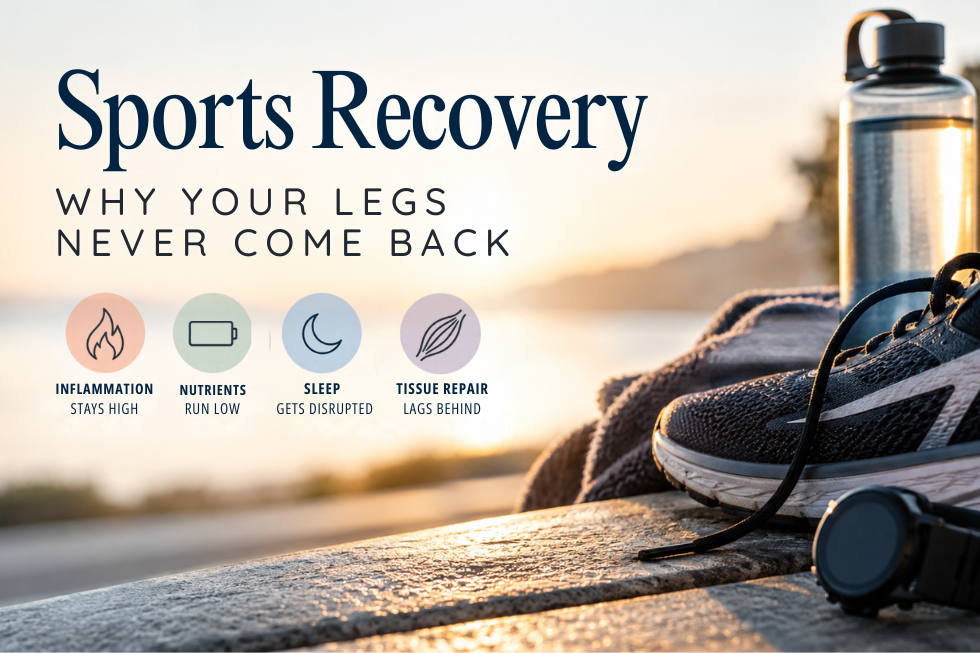
When the training is going in but the performance and recovery has plateaued
You had a good block. You did the volume, you did the intensity, you did not miss many sessions. And somewhere around the fourth week your legs stopped coming back.
Not injured. Nothing you could point to. Just heavy on the warm up, flat on the intervals, and a resting heart rate that sits a few beats higher than it used to. The session you did easily in March now costs you two days.
If you are in your forties or fifties this gets filed under age, usually by someone who has never asked you a single question about your week. If you are younger it gets filed under needing to train harder. Neither of those is a plan.
What is actually going on is more interesting than either, and it is worth understanding before you spend another block hoping it resolves on its own.
The part nobody measures
Training is not the thing that makes you fitter. Training is the stimulus. The adaptation happens afterward, in the hours and days when your body is repairing tissue, restocking what you used up and rebuilding a little stronger than before.
Almost every athlete tracks the stimulus in detail. Mileage, watts, sets, paces, splits. Almost nobody tracks the other side of the equation with anything like the same seriousness, because there is no obvious number for it.
So when the numbers stall, the instinct is to add stimulus. More volume, another block, a harder plan. Which is the correct instinct when recovery capacity is intact, and exactly the wrong one when it is not.
What it actually feels like
The textbook version of poor recovery is a list of terms. Here is the version you would recognize.
You are tired in a way that sleep does not fix, and yet your sleep itself has gone strange: falling asleep fine and waking at three, or sleeping eight hours and waking as though you did not. Your soreness lasts longer than it used to and shows up later. Motivation for the session is lower than your motivation for the sport, which is a distinction you can feel but find hard to explain.
Small things keep flaring. A tendon that grumbles for a week. A calf that keeps tightening. Nothing that stops you, all of it constant. Your warm up takes twice as long as it did a year ago before anything feels normal.
And the thing that bothers you most: the same session, at the same effort, delivers less than it used to. You are paying full price for the work and receiving a partial return
Dr. Zodkoy’s framing of what is falling behind
Dr. Steven Zodkoy, DC, CNS, DACBN, is Oxylon Wellness’s Clinical Protocol Advisor and Referral Partner, and he wrote the protocols Oxylon follows. He has spent more than 35 years working with chronic and difficult health issues, and he is the author of Misdiagnosed: The Adrenal Fatigue Link. He practices at Monmouth Advanced Medicine in New Jersey and does not practice at Oxylon.
His working view of sports recovery is direct. Recovery falters when four things happen together: inflammation stays high, nutrients run low, sleep is disrupted, and tissue repair lags behind training stress. The result, in his words, is fatigue, slower gains and higher injury risk.
Read that list again, because it explains something. Every item is a capacity, not an event. None of them is an injury you can point to on a scan. They are all the quiet infrastructure that determines what your training turns into.
Why the four hang together
What makes this framing useful is that the four items are not independent problems. They feed each other, which is why the picture tends to arrive all at once rather than one symptom at a time.
Inflammation that stays elevated after hard work interferes with sleep. Disrupted sleep reduces the window in which most repair happens. Repair that lags behind means the next session lands on tissue that has not finished adapting to the last one, which raises inflammation again. And through all of it, the nutrients used in repair and energy production are being drawn down faster than a normal diet replaces them.
That is a loop, and loops do not resolve by pushing harder on one point. It is also why the stalling feels so disproportionate to any single thing you did. No single thing did it.
The honest part: this is not one size fits all
Here is something Dr. Zodkoy says plainly that most recovery content leaves out.
Recovery varies by sex, age, sport and past injuries, among other things. The protocol he wrote is a general guideline that needs to be tailored to the individual.
That is worth respecting rather than skimming past. A forty eight year old masters cyclist coming back from a knee problem, a twenty six year old in a contact sport, and someone returning to running after two years away do not have the same recovery profile, and nobody who tells you otherwise is paying attention. The framework is common. The application is not.
Why the usual answers have felt incomplete
You have almost certainly tried the standard list. A deload week. More protein. Sleep hygiene. Compression, ice, foam rolling, a massage gun, an extra rest day.
None of that is wrong, and some of it genuinely helps. The reason it often feels like it is not enough is that most of it works on one of the four factors while the other three continue unchanged. A deload lowers the stimulus for a week but does nothing about nutrient status. More protein supports repair but does not address why sleep broke.
That is not a reason to abandon any of it. It is a reason to stop expecting one lever to move a four part system.
Recovery is a capacity you build, not a break you take
This is the reframe worth carrying away.
Most athletes think of recovery as an absence, the time when training is not happening. In this framing it is the opposite. It is an active capacity, it has inputs, and like any capacity it can be supported deliberately rather than hoped for.
That is also why the Oxylon sports recovery protocol is structured differently from the others Dr. Zodkoy wrote. It does not run for a set number of weeks and then finish. It runs on two rhythms: a denser one for acute episodes or for peaking before an event, and a lighter ongoing one for maintaining performance, because training does not stop and neither should the support around it. The second article on this page explains that structure and the reasoning behind it.
Where to start, in Orange County
If recovery has become the limiting factor in your training rather than effort, the useful first step is looking at the circulatory and stress side of the picture instead of adding another session.
Tell us how you train and where recovery is falling short. Fill out the short sports recovery form and our team at Oxylon Wellness in Costa Mesa will reach out.
Disclaimer:
This article is for educational purposes only and is not medical advice. Oxylon Wellness does not diagnose, treat, or cure any medical condition, and the protocols described are wellness programs intended to run alongside, not in place of, care from your own physician. Individual experiences vary. Always consult your healthcare provider before beginning any new wellness program, dietary change, or supplement, and check for allergies. Protocols were developed by Dr. Steven Zodkoy, DC, CNS, DACBN, who is Oxylon Wellness’s Clinical Protocol Advisor and Referral Partner and does not practice at Oxylon Wellness.